Description
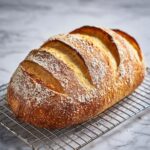
This Homemade Sourdough Batard Bread recipe guides you through creating a flavorful, crusty loaf using a poolish starter and traditional baking techniques. Featuring a long fermentation process and steam-assisted baking, this bread boasts a complex flavor profile with an airy crumb and a deep golden crust.
Ingredients
Scale
Poolish
- 100 g bread flour (unbleached, high-protein flour like King Arthur)
- 100 g water (room temperature)
- 0.5 g instant yeast
Dough
- 400 g bread flour (unbleached, high-protein flour like King Arthur)
- 250 g water (room temperature)
- 10 g salt (fine sea salt)
- 2 g instant yeast
- 5 g diastatic malt powder
- 0.5 g ascorbic acid powder
Instructions
- Prepare the Poolish: In a bowl, mix 100 g bread flour, 100 g water, and 0.5 g instant yeast. Stir until smooth, cover, and let it rest at room temperature for 12 hours until it develops bubbles and a slightly domed surface, indicating readiness.
- Autolyse the Dough: In a large bowl, whisk together 400 g bread flour and 250 g water until no dry flour remains. Cover the bowl and rest the mixture for 30 minutes to align gluten strands, easing dough handling.
- Mix Dough Ingredients: Sprinkle 10 g salt, 2 g instant yeast, 5 g diastatic malt powder, and 0.5 g ascorbic acid powder over the autolysed dough. Add the entire poolish and fold until incorporated into a uniform dough.
- Bulk Fermentation with Stretch-and-Folds: Every 30 minutes during a 2-hour bulk fermentation at 75°F, perform four stretch-and-folds by reaching under one side of the dough, stretching it up, folding it over, and rotating the bowl 90°. This strengthens the dough and develops air pockets.
- Cold Fermentation: Transfer the dough to a lightly oiled container, cover, and refrigerate for 12 to 18 hours to deepen flavor and allow flexible baking timing.
- Pre-shape the Dough: Turn the dough onto a floured surface, flatten into a rectangle, fold the top third down and bottom third up, then rotate 90° and repeat. Rest seam side up for 15 minutes.
- Final Shaping: Dust the surface with flour and flatten the dough into a 10×8-inch rectangle. Fold sides toward center, seal seams with fingertips, turn seam side down, and roll into a 12-inch long batard. Place on parchment and cover for proofing.
- Final Proof: Proof at room temperature (70°F to 75°F) for 60 to 75 minutes until it passes the poke test—slow spring back upon gentle poke.
- Preheat and Bake: Preheat oven to 475°F with a baking stone or steel on the middle rack and steam pan on the floor for at least 45 minutes. Transfer the loaf with parchment to the stone, score a 6-inch slash down the center, pour 1 cup hot water into steam pan, and close oven door. Bake 15 minutes, reduce temperature to 440°F, bake 15 more minutes, remove steam pan, and bake until crust is deep golden brown.
- Cool: Remove loaf using parchment and place on a cooling rack. Allow to cool completely for about 2 hours before slicing.
Notes
- Using a baking stone or steel with steam improves crust texture and oven spring.
- Diastatic malt powder enhances yeast activity and crust browning.
- Ascorbic acid powder strengthens gluten and boosts rise.
- Cold fermentation develops deeper flavor and flexible schedule.
- Perform stretch-and-folds gently to avoid degassing the dough.
- Allow the bread to cool fully to finish the crumb setting before slicing.